---
title: "Revolutionierung der Zytokinforschung: InVivoKines™ von AdipoGen Life Sciences"
description: Die InVivoKines™ sind eine neue Generation von Fusionsproteinen mit verbesserter Aktivität und Stabilität für Ihre in vivo-Forschung!
image: https://ressourcen.biomol.com/hubfs/Imported_Blog_Media/InVivoKines_Preview-3.png
---
de
DE EN
[** Mein Konto ](https://www.biomol.com/de/account)
** Service/Hilfe
- [Kontakt](https://www.biomol.com/de/kontakt)
- [Technischer Kundenservice](https://www.biomol.com/de/technischer-kundenservice)
- [FAQ](https://support.biomol.com/de/?hsLang=de)
- [Versandkosten](https://www.biomol.com/de/versandkosten)
- [Produkt-Suchtipps](https://www.biomol.com/de/produkt-suchtipps)
- [Distributoren](https://www.biomol.com/de/distributoren)
- [Firmengeschichte](https://www.biomol.com/de/firmengeschichte)
- Cookie-Einstellungen
- [** Menü ](https://ressourcen.biomol.com/de/biomol-blog/revolutionierung-der-zytokinforschung-invivokines-von-adipogen-life-sciences#offcanvas--left)
- [**Suchtipps ](https://www.biomol.com/de/produkt-suchtipps)
- [** Suchen ](https://ressourcen.biomol.com/de/biomol-blog/revolutionierung-der-zytokinforschung-invivokines-von-adipogen-life-sciences#show-hide--search)
** Suchen
- [** ](https://www.biomol.com/de/produkt-suchtipps)
- [** Mein Konto ](https://www.biomol.com/de/account)
- [Produkte ](https://www.biomol.com/products/)
- [Hersteller ](https://www.biomol.com/de/hersteller/)
- [Ressourcen ](https://www.biomol.com/de/ressourcen/)
- [Aktionen ](https://www.biomol.com/de/aktionen/)
- [Über Biomol ](https://www.biomol.com/de/ueber-biomol/)
- [** Mein Konto ](https://www.biomol.com/de/account)
[** Zur Kategorie Hersteller ](https://www.biomol.com/de/produkte/) **
- [Antikörper](https://www.biomol.com/de/produkte/antikoerper/)
- [Primärantikörper](https://www.biomol.com/de/produkte/antikoerper/primaerantikoerper/)
- [Sekundärantikörper](https://www.biomol.com/de/produkte/antikoerper/sekundaerantikoerper/)
- [Igs und Isotypkontrollen](https://www.biomol.com/de/produkte/antikoerper/igs-und-isotypkontrollen/)
- [Antikörper-Panels](https://www.biomol.com/de/produkte/antikoerper/antikoerper-panels/)
- [Assay-Kits](https://www.biomol.com/de/produkte/assay-kits/)
- [ELISA und Immunassays](https://www.biomol.com/de/produkte/assay-kits/elisa-und-immunassays/)
- [Biochemische Assays](https://www.biomol.com/de/produkte/assay-kits/biochemische-assays/)
- [Zellbasierte Assays](https://www.biomol.com/de/produkte/assay-kits/zellbasierte-assays/)
- [Biologische Proben](https://www.biomol.com/de/produkte/biologische-proben/)
- [Zellen](https://www.biomol.com/de/produkte/biologische-proben/zellen/)
- [Virus-basierte Tools](https://www.biomol.com/de/produkte/biologische-proben/virus-basierte-tools/)
- [Lysate](https://www.biomol.com/de/produkte/biologische-proben/lysate/)
- [Nukleinsäuren](https://www.biomol.com/de/produkte/biologische-proben/nukleinsaeuren/)
- [Blutprodukte](https://www.biomol.com/de/produkte/biologische-proben/blutprodukte/)
- [Gewebe](https://www.biomol.com/de/produkte/biologische-proben/gewebe/)
- [Sonstige](https://www.biomol.com/de/produkte/biologische-proben/sonstige/)
- [Chemikalien](https://www.biomol.com/de/produkte/chemikalien/)
- [Biochemikalien](https://www.biomol.com/de/produkte/chemikalien/biochemikalien/)
- [Lipide](https://www.biomol.com/de/produkte/chemikalien/lipide/)
- [Referenzstandards](https://www.biomol.com/de/produkte/chemikalien/referenzstandards/)
- [Farbstoffe und Labeling](https://www.biomol.com/de/produkte/chemikalien/farbstoffe-und-labeling/)
- [Antibiotika](https://www.biomol.com/de/produkte/chemikalien/antibiotika/)
- [Biologische Puffer](https://www.biomol.com/de/produkte/chemikalien/biologische-puffer/)
- [Detergenzien](https://www.biomol.com/de/produkte/chemikalien/detergenzien/)
- [CpG-ODN's](https://www.biomol.com/de/produkte/chemikalien/cpg-odn-s/)
- [Screening-Libraries](https://www.biomol.com/de/produkte/chemikalien/screening-libraries/)
- [Plasmide](https://www.biomol.com/de/produkte/plasmide/)
- [cDNA-Klone](https://www.biomol.com/de/produkte/plasmide/cdna-klone/)
- [Sonstige](https://www.biomol.com/de/produkte/plasmide/sonstige/)
- [Primer](https://www.biomol.com/de/produkte/primer/)
- [qPCR Primer](https://www.biomol.com/de/produkte/primer/qpcr-primer/)
- [qPCR Genfamilien-Primer](https://www.biomol.com/de/produkte/primer/qpcr-genfamilien-primer/)
- [qPCR Kontroll-Primer](https://www.biomol.com/de/produkte/primer/qpcr-kontroll-primer/)
- [qPCR Primer-Libraries](https://www.biomol.com/de/produkte/primer/qpcr-primer-libraries/)
- [Proteine und Peptide](https://www.biomol.com/de/produkte/proteine-und-peptide/)
- [Proteine](https://www.biomol.com/de/produkte/proteine-und-peptide/proteine/)
- [Zytokine](https://www.biomol.com/de/produkte/proteine-und-peptide/zytokine/)
- [Peptide](https://www.biomol.com/de/produkte/proteine-und-peptide/peptide/)
- [Toolkits](https://www.biomol.com/de/produkte/toolkits/)
- [Kit-Komponenten](https://www.biomol.com/de/produkte/toolkits/kit-komponenten/)
- [Labeling-Kits](https://www.biomol.com/de/produkte/toolkits/labeling-kits/)
- [Kits zur Probenvorbereitung](https://www.biomol.com/de/produkte/toolkits/kits-zur-probenvorbereitung/)
- [Klonierungs- und Expressionskits](https://www.biomol.com/de/produkte/toolkits/klonierungs-und-expressionskits/)
- [Mutagenese-Kits](https://www.biomol.com/de/produkte/toolkits/mutagenese-kits/)
- [Sequenzierungskits](https://www.biomol.com/de/produkte/toolkits/sequenzierungskits/)
- [Zusätzliche Reagenzien](https://www.biomol.com/de/produkte/zusaetzliche-reagenzien/)
- [Färbelösungen](https://www.biomol.com/de/produkte/zusaetzliche-reagenzien/faerbeloesungen/)
- [Zellkulturmedien](https://www.biomol.com/de/produkte/zusaetzliche-reagenzien/zellkulturmedien/)
- [Agarosen](https://www.biomol.com/de/produkte/zusaetzliche-reagenzien/agarosen/)
- [Stabilisatoren](https://www.biomol.com/de/produkte/zusaetzliche-reagenzien/stabilisatoren/)
- [Protein-Marker](https://www.biomol.com/de/produkte/zusaetzliche-reagenzien/protein-marker/)
- [DNA-Leitern](https://www.biomol.com/de/produkte/zusaetzliche-reagenzien/dna-leitern/)
- [Transfektionsreagenzien](https://www.biomol.com/de/produkte/zusaetzliche-reagenzien/transfektionsreagenzien/)
[** Zur Kategorie Hersteller ](https://www.biomol.com/de/produkte/) **
- [AAT Bioquest](https://www.biomol.com/de/aat-bioquest/)
- [Abcore](https://www.biomol.com/de/abcore/)
- [Absea](https://www.biomol.com/de/absea/)
- [Acepix Biosciences](https://www.biomol.com/de/acepix/)
- [AdipoGen Life Sciences](https://www.biomol.com/de/adipogen/)
- [Akadeum Life Sciences](https://www.biomol.com/de/akadeum-life-sciences/)
- [Alithea Genomics](https://www.biomol.com/de/alithea-genomics/)
- [Amsbio](https://www.biomol.com/de/amsbio/)
- [Ancell](https://www.biomol.com/de/ancell/)
- [Arigo Biolaboratories](https://www.biomol.com/de/arigo/)
- [Assay Genie](https://www.biomol.com/de/assay-genie/)
- [AssayQuant](https://www.biomol.com/de/assayquant/)
- [Atlas Antibodies](https://www.biomol.com/de/atlas-antibodies/)
- [Badische Peptide & Proteine](https://www.biomol.com/de/bpp/)
- [Bertin Bioreagent](https://www.biomol.com/de/bertin-bioreagent/)
- [Bethyl Laboratories](https://www.biomol.com/de/bethyl/)
- [Biomol GmbH](https://www.biomol.com/de/biomol-gmbh/)
- [Biotium](https://www.biomol.com/de/biotium/)
- [BPS Bioscience](https://www.biomol.com/de/bps/)
- [Cavidi](https://www.biomol.com/de/cavidi/)
- [Cayman Chemical](https://www.biomol.com/de/cayman/)
- [Chemodex](https://www.biomol.com/de/chemodex/)
- [Chimerigen Laboratories](https://www.biomol.com/de/chimerigen/)
- [Croyez](https://www.biomol.com/de/croyez/)
- [Cusabio](https://www.biomol.com/de/cusabio/)
- [Cytion](https://www.biomol.com/de/cytion/)
- [Diaclone](https://www.biomol.com/de/diaclone/)
- [DIMA Biotech](https://www.biomol.com/de/dima/)
- [Elabscience](https://www.biomol.com/de/elabscience/)
- [ELK Biotechnology](https://www.biomol.com/de/elk-biotechnology/)
- [Expert Synthesis Solutions](https://www.biomol.com/de/ess/)
- [ForMedium](https://www.biomol.com/de/formedium/)
- [GenScript](https://www.biomol.com/de/genscript/)
- [Hycult Biotech](https://www.biomol.com/de/hycult-biotech/)
- [ImmunoChemistry](https://www.biomol.com/de/ict/)
- [Indigo Biosciences](https://www.biomol.com/de/indigo/)
- [Innaxon](https://www.biomol.com/de/innaxon/)
- [InVitria](https://www.biomol.com/de/invitria/)
- [IsoSciences](https://www.biomol.com/de/isosciences/)
- [JaICA](https://www.biomol.com/de/jaica/)
- [KACTUS](https://www.biomol.com/de/kactus/)
- [Kingfisher Biotech](https://www.biomol.com/de/kingfisher/)
- [LKT Laboratories](https://www.biomol.com/de/lkt/)
- [LubioScience](https://www.biomol.com/de/lubioscience/)
- [Micronbrane Medical](https://www.biomol.com/de/micronbrane/)
- [MONOSAN](https://www.biomol.com/de/monosan/)
- [nanoComposix](https://www.biomol.com/de/nanocomposix/)
- [Navinci Diagnostics](https://www.biomol.com/de/navinci/)
- [NeoBiotechnologies](https://www.biomol.com/de/neobiotechnologies/)
- [NewEast Biosciences](https://www.biomol.com/de/neweastbio/)
- [Novoprotein](https://www.biomol.com/de/novoprotein/)
- [NSJ Bioreagents](https://www.biomol.com/de/nsjbio/)
- [NuSep](https://www.biomol.com/de/nusep/)
- [NZYtech](https://www.biomol.com/de/nzytech/)
- [ORF Genetics](https://www.biomol.com/de/orf-genetics/)
- [Pacific Coast Bio](https://www.biomol.com/de/pacific-coast-bio/)
- [Peptides & Elephants](https://www.biomol.com/de/peptides-and-elephants/)
- [Quantoom Biosciences](https://www.biomol.com/de/quantoom/)
- [Randox](https://www.biomol.com/de/randox/)
- [RealTimePrimers](https://www.biomol.com/de/realtimeprimers/)
- [Research Donors](https://www.biomol.com/de/research-donors/)
- [RevMAb Biosciences](https://www.biomol.com/de/revmab/)
- [Rockland Immunochemicals](https://www.biomol.com/de/rockland/)
- [Slingshot Biosciences](https://www.biomol.com/de/slingshot/)
- [South Bay Bio](https://www.biomol.com/de/south-bay-bio/)
- [SYNkinase](https://www.biomol.com/de/synkinase/)
- [TargetMol](https://www.biomol.com/de/targetmol/)
- [U-genes](https://www.biomol.com/de/u-genes/)
- [United States Biological](https://www.biomol.com/de/usbiological/)
- [Virax Biolabs](https://www.biomol.com/de/virax-biolabs/)
[** Zur Kategorie Hersteller ](https://www.biomol.com/de/produkte/) **
- [Biomol Blog](https://ressourcen.biomol.com/de/biomol-blog)
- [Anwendungen](https://www.biomol.com/de/ressourcen/anwendungen/)
- [Webinare](https://www.biomol.com/de/ressourcen/webinare/bps-bioscience/)
- [Protokolle](https://www.biomol.com/de/ressourcen/protokolle/)
- [Standard-Puffer](https://www.biomol.com/de/ressourcen/standard-puffer/)
- [Kataloge](https://www.biomol.com/de/ressourcen/kataloge/)
- [Poster](https://www.biomol.com/de/ressourcen/poster/)
- [Tagungskalender](https://www.biomol.com/de/ressourcen/tagungskalender/)
- [Newsletter](https://www.biomol.com/de/newsletter)
- [Tools](https://www.biomol.com/de/ressourcen/tools/molaritaetsrechner/)
- [Molaritätsrechner](https://www.biomol.com/de/ressourcen/tools/molaritaetsrechner/)
- [Zytokin-Aktivitätsrechner](https://www.biomol.com/de/ressourcen/tools/zytokin-aktivitaetsrechner/)
- [ELISA Analyse](https://www.biomol.com/de/ressourcen/tools/elisa-analyse/)
- [Fluoreszenz-Spektrum Viewer](https://www.biomol.com/de/ressourcen/tools/fluoreszenz-spektrum-viewer/)
Ressourcen
An dieser Stelle finden Sie unter anderem Protokolle und Anleitungen für verschiedene Applikationen. Laden Sie sich außerdem die neuesten Kataloge und Broschüren unserer Partner als PDF herunter und erfahren Sie, wo Sie uns auf Konferenzen... [ mehr erfahren ](https://www.biomol.com/de/ressourcen/)
[** Zur Kategorie Hersteller ](https://www.biomol.com/de/produkte/) **
- [Firmengeschichte](https://www.biomol.com/de/firmengeschichte)
- [Auszeichnungen](https://www.biomol.com/de/awards)
- [Kontakt](https://www.biomol.com/de/kontaktformular)
- [Technischer Kundenservice](https://www.biomol.com/de/technischer-kundenservice)
- [Karriere](https://www.biomol.com/de/jobangebote)
- [FAQ](https://support.biomol.com/de/?hsLang=de)
- [ Menü schließen ** ](https://ressourcen.biomol.com/de/biomol-blog/revolutionierung-der-zytokinforschung-invivokines-von-adipogen-life-sciences#close-categories-menu)
de
EN
Kategorien
- [Produkte](https://www.biomol.com/products/)
- [Hersteller](https://www.biomol.com/de/hersteller/)
- [Ressourcen](https://www.biomol.com/de/ressourcen/)
- [Aktionen](https://www.biomol.com/de/aktionen/)
- [Über Biomol](https://www.biomol.com/de/ueber-biomol/)
Informationen
- [Kontakt](https://www.biomol.com/de/kontakt)
- [Technischer Kundenservice](https://www.biomol.com/de/technischer-kundenservice)
- [FAQ](https://support.biomol.com/de/?hsLang=de)
- [Versandkosten](https://www.biomol.com/de/versandkosten)
- [Produkt-Suchtipps](https://www.biomol.com/de/produkt-suchtipps)
- [Distributoren](https://www.biomol.com/de/distributoren)
- [Firmengeschichte](https://www.biomol.com/de/firmengeschichte)
- Cookie-Einstellungen
- [Home](https://www.biomol.com/de)
- [Blog](https://ressourcen.biomol.com/de/biomol-blog)
- Revolutionierung der Zytokinforschung: InVivoKines™ von AdipoGen Life Sciences
- [AdipoGen](https://ressourcen.biomol.com/de/biomol-blog/tag/adipogen)
- [Proteine](https://ressourcen.biomol.com/de/biomol-blog/tag/proteine)
- [Interleukine](https://ressourcen.biomol.com/de/biomol-blog/tag/interleukine)
- [Entzündung](https://ressourcen.biomol.com/de/biomol-blog/tag/entzündung)
- [Immuntherapie](https://ressourcen.biomol.com/de/biomol-blog/tag/immuntherapie)
# Revolutionierung der Zytokinforschung: InVivoKines™ von AdipoGen Life Sciences
Geschrieben von: Emily Locke 06-19-2024
Beitrag auf sozialen Medien teilen:
[Auf Whatsapp teilen ](whatsapp://send?text=https://ressourcen.biomol.com/de/biomol-blog/revolutionierung-der-zytokinforschung-invivokines-von-adipogen-life-sciences) [Auf X teilen ](https://twitter.com/intent/tweet?source=https://ressourcen.biomol.com/de/biomol-blog/revolutionierung-der-zytokinforschung-invivokines-von-adipogen-life-sciences&text=Revolutionierung%20der%20Zytokinforschung:%20InVivoKines™%20von%20AdipoGen%20Life%20Sciences%20-%20https://ressourcen.biomol.com/de/biomol-blog/revolutionierung-der-zytokinforschung-invivokines-von-adipogen-life-sciences) [Auf LinkedIn teilen ](https://www.linkedin.com/shareArticle?mini=true&url=https://ressourcen.biomol.com/de/biomol-blog/revolutionierung-der-zytokinforschung-invivokines-von-adipogen-life-sciences) [Auf Facebook teilen ](https://www.facebook.com/sharer/sharer.php?u=https://ressourcen.biomol.com/de/biomol-blog/revolutionierung-der-zytokinforschung-invivokines-von-adipogen-life-sciences)
Die Bedeutung von Antikörpern, T- und B-Lymphozyten, dendritischen Zellen, Makrophagen und Co. für die Abwehr von Krankheitserregern ist eindeutig. Doch neben diesen allgemein bekannten Abwehrkomponenten gibt es auch die stillen Helden unseres körpereigenen Immunsystems wie beispielsweise Zytokine. Diese kleinen Signalproteine sind für die Zellkommunikation unerlässlich, da sie als Botenstoffe des Immunsystems dienen und daher eine entscheidende Rolle bei der Regulierung von Immunantworten, Entzündungen und der Hämatopoese spielen. Außerdem gehört das Einleiten der Proliferation und Differenzierung von Zielzellen zu ihren Aufgaben [1]. Zytokine werden unter anderem von Makrophagen, B- und T-Lymphozyten, natürlichen Killerzellen und Fibroblasten gebildet [2]. Aufgrund ihrer zentralen Rolle bei der Immunantwort stellen Zytokine ein attraktives Ziel für die präklinische und klinische Erforschung einer Vielzahl von Immunkrankheiten dar. Doch trotz ihres Potentials ist die Untersuchung dieser dynamischen Moleküle in lebenden Organismen eine herausfordernde Aufgabe. Schuld daran sind die kurze Halbwertszeit im Blut, Pleotropie und eine ungünstige Biodistribution [3].
Hier kommt unser Hersteller [AdipoGen Life Sciences](https://www.biomol.com/de/adipogen/) mit einer innovativen Produktlinie ins Spiel: Die [InVivoKines™](https://www.biomol.com/dateien/AdipoGen--InVivoKines.pdf) sind eine neue Generation von Fusionsproteinen mit verbesserter Aktivität und Stabilität für Ihre *in vivo*-Forschung! Sie ermöglichen es Wissenschaftler*innen, tiefer in die komplexe Welt der Zytokine in lebenden Organismen einzutauchen, neue Erkenntnisse zu gewinnen und Türen zu wirksamen Therapien zu öffnen. Hier erfahren Sie mehr über die Technologie, die hinter den InVivoKines™ steckt, und erhalten einen Überblick über die unterschiedlichen Produktarten und ihre Anwendungen.
### Diese Themen warten auf Sie:
[1) Was sind InVivoKines™?](https://ressourcen.biomol.com/de/biomol-blog/revolutionierung-der-zytokinforschung-invivokines-von-adipogen-life-sciences#1)
[2) Was hinter den InVivoKines™ steckt: die Knobs-into-Holes-Technologie](https://ressourcen.biomol.com/de/biomol-blog/revolutionierung-der-zytokinforschung-invivokines-von-adipogen-life-sciences#2)
[3) „Ausgeschaltete“ InVivoKines™: die LALA-PG-Mutationen](https://ressourcen.biomol.com/de/biomol-blog/revolutionierung-der-zytokinforschung-invivokines-von-adipogen-life-sciences#3)
[4) InVivoKines™: Proteine mit verbesserter Aktivität und Stabilität für die *in vivo*-Forschung](https://ressourcen.biomol.com/de/biomol-blog/revolutionierung-der-zytokinforschung-invivokines-von-adipogen-life-sciences#4)
[5) Wirksame monomere Zytokine: Interleukin-2](https://ressourcen.biomol.com/de/biomol-blog/revolutionierung-der-zytokinforschung-invivokines-von-adipogen-life-sciences#5)
[6) Hochaktive heterodimere Zytokine: Interleukin-27](https://ressourcen.biomol.com/de/biomol-blog/revolutionierung-der-zytokinforschung-invivokines-von-adipogen-life-sciences#6)
[7) Einzigartige homodimere Zytokine: GDF-15](https://ressourcen.biomol.com/de/biomol-blog/revolutionierung-der-zytokinforschung-invivokines-von-adipogen-life-sciences#7)
[](https://hubspot-cta-redirect-eu1-prod.s3.amazonaws.com/cta/redirect/144662462/9d75e303-73aa-4ce9-8cf1-9d9598780cc0)
## Was sind InVivoKines™?
Bei den InVivoKines™ von AdipoGen Life Sciences handelt es sich um rekombinante Fusionsproteine – doch was genau bedeutet das eigentlich? Ein Protein bezeichnet man als rekombinant, wenn es künstlich mit Hilfe von gentechnisch veränderten Mikroorganismen oder in Zellkulturen hergestellt wird [4]. Ein Fusionsprotein entsteht durch die gemeinsame Expression zwei verschiedener Gene oder Genabschnitte, die hintereinander im Genom liegen. In dem Proteinmolekül sind also Genprodukte von mindestens zwei verschiedenen Genen enthalten [5].
In vielen Fällen kann das Fusionieren von Proteindomänen dazu beitragen, dass die Stabilität bzw. die Halbwertszeit des Proteins erhöht wird [3]. Hierzu nutzt man oft die Fc-Domäne von Antikörpern. Kurz zur Wissensauffrischung: Antikörper bestehen aus zwei Fragmenten, der variablen Fab-Domäne und der konstanten Fc-Domäne (Abb. 1). Während die Fab-Domäne für die Antigenbindung zuständig ist, übernimmt die Fc-Domäne die Effektorfunktionen des Antikörpers, indem sie an Fcγ-Rezeptoren auf Immunzellen bindet oder das Komplementsystem aktiviert [6]. Darüber hinaus sorgt die Fc-Domäne für eine lange Halbwertszeit des Antikörpers, weshalb sie oft für Fusionsproteine in *in vivo*-Studien verwendet wird [3].
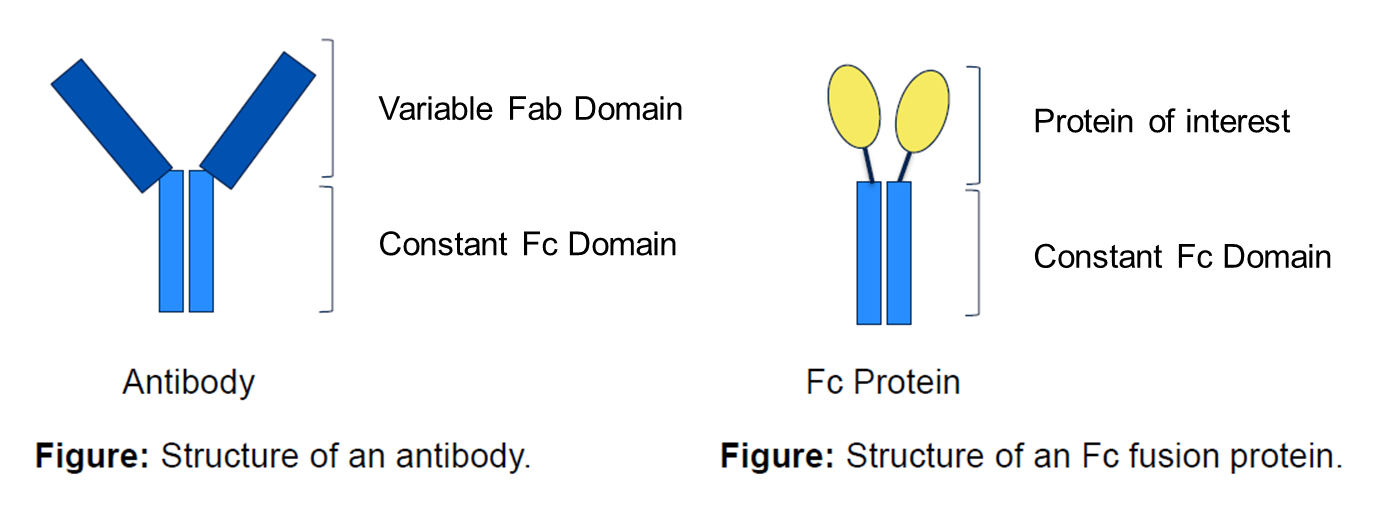
*Abbildung 1: Vergleich der Struktur eines Antikörpers und eines Fc-Fusionsproteins. Ein Antikörper besteht aus einer variablen Fab-Domäne und einer konstanten Fc-Domäne. Ein herkömmliches Fc-Fusionsprotein besteht aus einer Fc-Domäne und einem Zielprotein. Aufgrund der Dimerisierung der Fc-Domäne entsteht ein homodimeres Fusionsprotein.*
Doch das Fusionieren eines Proteins mit einem Fc-Fragment hat mehr Auswirkungen als nur die Erhöhung der Halbwertszeit: Da eine Dimerisierung für die Aktivierung der Fc-Domäne notwendig ist, entsteht beim Fusionieren dieses Fragments an ein Zielprotein ein homodimeres Protein (Abb. 1). In vielen Fällen ist das von Vorteil, da einige Proteine in Form eines Homodimers aktiver sind. Bei anderen Proteinen kann die Dimerisierung durch Fc-Fragmente ihre Aktivität jedoch auch drastisch senken. Dies ist insbesondere bei Zytokinen oder Interleukinen ein Problem, da sie normalerweise als Monomer oder Heterodimer vorliegen [3].
## Was hinter den InVivoKines™ steckt: die Knobs-into-Holes-Technologie
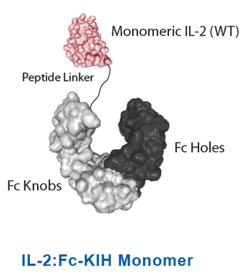
Wie ist es möglich, ein langlebiges Fc-Fusionsprotein für die *in vivo*-Forschung zu entwickeln, das als Monomer oder Heterodimer, aber nicht als Homodimer vorliegt? Mit den selbstentwickelten InVivoKines™ hat unser Hersteller AdipoGen Life Sciences die Antwort auf diese Frage gefunden und erfolgreich umgesetzt. Dazu nutzt unser Immunologie-Spezialist eine im Jahre 1996 von Ridgway *et al.* vorgestellte Methode namens Fc-*Knobs-into-Holes* oder kurz Fc-KIH [7]. Traditionell zur Entwicklung bispezifischer Antikörper eingesetzt, ermöglicht diese bahnbrechende Technologie die Heterodimerisierung zweier verschiedener Fc-Fragmente, wodurch eine Struktur mit zwei unterschiedlichen „Armen“ entsteht. Dies ermöglicht das Herstellen von natürlich vorkommenden, aktiven monomeren oder heterodimeren Fusionsroteinen – so auch von Zytokinen (Abb. 2).
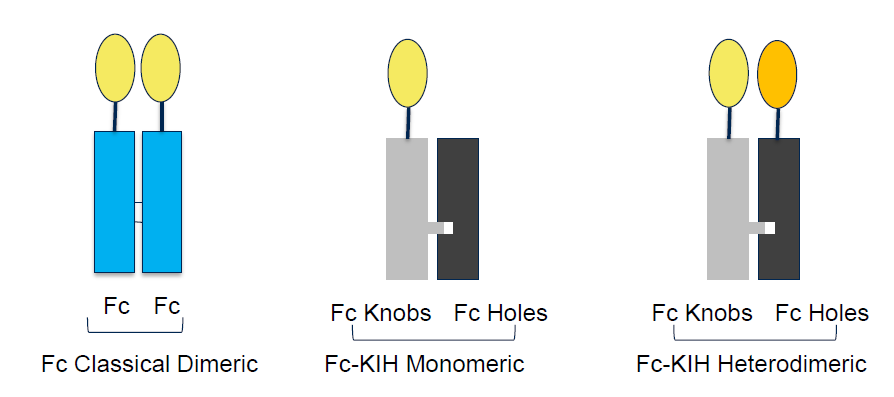
*Abbildung 2: Vergleich der Struktur eines klassischen Fc-Fusionsproteins und eines Fc-KIH-Fusionsproteins. Während die herkömmlichen Fc-Fusionsproteine als Homodimere vorliegen, ermöglicht die KIH-Technologie darüber hinaus die Entwicklung monomerer und heterodimerer Fusionsproteine.*
Doch wie genau erhält man die zwei verschiedenen Fc-Arme? Dazu werden wichtige Aminosäurereste, die an der dimeren Interaktion von Fc beteiligt sind, manipuliert. Aminosäurereste mit einer kleinen Seitenkette werden durch solche mit größeren ersetzt, wodurch in der einen Kette ein Knubbel oder *Knob* entsteht. Umgekehrt werden in der Partnerkette Aminosäurereste mit einer großen Seitenkette durch kleinere ersetzt, um ein Loch oder *Hole* zu erzeugen. Üblicherweise wird eine T366Y-Mutation in einer CH3-Domäne genutzt, um einen *Knob* zu erschaffen, während eine Y407T-Mutation in der anderen CH3-Domäne ein *Hole* verursacht. Solche Mutationen führen zu intermolekularen Wechselwirkungen und fördern die Bildung von Heterodimeren durch die Paarung von *Knob* und *Hole *[3].
## „Ausgeschaltete“ InVivoKines™: die LALA-PG-Mutationen
Wie bereits erwähnt, binden Fc-Fragmente an Fcγ-Rezeptoren (FcγRs) auf Immunzellen oder aktivieren das Komplementsystem. Dadurch können sie verschiedene immunologische Mechanismen auslösen, darunter die antikörperabhängige zellvermittelte Zytotoxizität (*antibody dependent cell mediated cytotoxicity*, ADCC), die antikörperabhängige zellvermittelte Phagozytose (*antibody dependent cell mediated phagocytosis*, ADCP) und die komplementabhängige Zytotoxizität (*complement dependent cytotoxicity*, CDC) [3]. Neben FcγRs binden Fc-Fragmente außerdem an den neonatalen Fc-Rezeptor, kurz FcRn. Die Bindung an diesen Rezeptor verhindert den Abbau der Antikörper bzw. Fusionsproteine und verlängert somit ihre Halbwertszeit im Blut [8].
Obwohl die Effektorfunktionen der Fc-Domäne ein wichtiger Bestandteil unserer Immunabwehr sind und unter anderem bei der Bekämpfung von Tumorzellen eine entscheidende Rolle spielen, kann es für bestimmte Forschungsexperimente interessant sein, Fc-Domänen einzusetzen, denen diese Funktionen fehlen. Deswegen bietet AdipoGen die InVivoKines auch mit „abgeschalteten“ (*silenced*) Fc-KIH-Domänen an. Hierzu werden die hlgG1 P329G LALA-Mutationen, kurz LALA-PG, verwendet, welche die Interaktionen mit FcγRs und dem Komplementsystem unterdrücken – die Interaktion mit dem FcRn bleibt jedoch unbeeinflusst (Abb. 3) [3]. Der Vorteil von den InVivoKines™ LALA-PG besteht somit darin, dass auf der einen Seite die immunologischen Nebenwirkungen aufgrund der Fc-KIH-Fusionsdomäne vermieden werden, auf der anderen Seite die erhöhte Halbwertszeit *in vivo* jedoch erhalten bleibt.
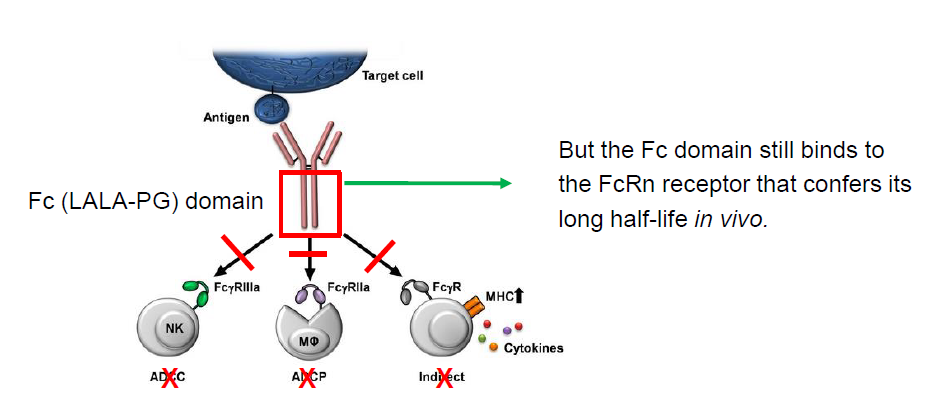
*Abbildung 3: Inhibierung der Fc-Effektorfunktionen durch LALA-PG-Mutationen. Die LALA-PG-Mutationen verhindern das Auslösen verschiedener immunologischer Mechanismen (darunter ADCC und ADCP) sowie die Aktivierung des Komplementsystems (CDC). Die Bindung zum neonatalen Fc-Rezeptor und die damit verbundene erhöhte Halbwertszeit in vivo bleibt jedoch erhalten.*
[](https://www.biomol.com/dateien/AdipoGen--InVivoKines.pdf)
## InVivoKines™: Proteine mit verbesserter Aktivität und Stabilität für die *in vivo*-Forschung
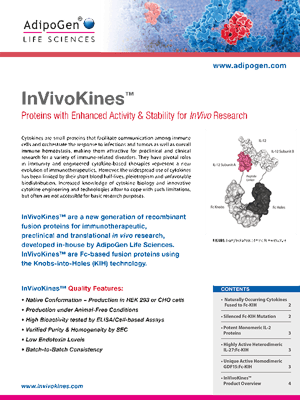
Jetzt kennen Sie die Hintergründe der InVivoKinesTM. Haben wir Ihr Interesse geweckt? Dann entdecken Sie hier die verschiedenen Produkte, die diese neue Produktlinie mit sich bringt und die Ihre immuntherapeutische, präklinische und translationale *in vivo*-Forschung unterstützen können. Alle InVivoKinesTM von AdipoGen weisen die folgenden Qualitätsmerkmale auf:
- Native Konformation – Herstellung in HEK 293- oder CHO-Zellen
- Produktion unter tierversuchsfreien Bedingungen
- Hohe Bioaktivität getestet durch ELISA/Zell-basierte Assays
- Geprüfte Reinheit & Homogenität durch SEC
- Niedrige Endotoxin-Werte
- Konsistenz von Charge zu Charge
Werfen Sie außerdem einen Blick in AdipoGens Broschüre (s. rechts), in der Sie weitere, detaillierte Informationen rund um die InVivoKinesTM finden können.
### Wirksame monomere Zytokine: Interleukin-2
Interleukin-2 (IL-2) ist ein Zytokin aus der Familie der Interleukine, dessen Hauptwirkung in der autokrinen Stimulation von T-Helfer-Zellen besteht [9]. Darüber hinaus fördert es die Proliferation und Differenzierung von Effektor-T-Zellen (CD4 und CD8) und natürlichen Killerzellen (NKs) und wird daher häufig in der Zelltherapie mit Tumor-infiltrierenden Lymphozyten (TILs) zur Förderung der T-Zell-Expansion eingesetzt. Das [IL-2-Superkine (monomeric):Fc-KIH](https://www.biomol.com/de/produkte/proteine-und-peptide/zytokine/rekombinant/il-2-superkine-monomeric-fc-kih-human-rec.-ag-40b-0222-c010) von AdipoGen Life Sciences induziert eine wirksame Antitumorreaktion und kann sowohl *in vitro* als auch *in vivo* eingesetzt werden. Das IL-2-InVivoKine™ ist aufgrund seiner hohen Aktivität und langen Halbwertszeit im Blut insbesondere für *in vivo*-Studien einzigartig [3].
| **Produktnummer** | **Produktname** | **Proteinkonstrukt** |
| --- | --- | --- |
| AG-40B-0224-C010 | [IL-2 (human) (monomeric):Fc-KIH (human) (rec.)](https://www.biomol.com/de/produkte/proteine-und-peptide/zytokine/rekombinant/il-2-human-monomeric-fc-kih-human-rec.-ag-40b-0224-c010) | Monomer |
| AG-40B-0225-C010 | [IL-2 (mouse) (monomeric):Fc-KIH (human) (rec.)](https://www.biomol.com/de/produkte/proteine-und-peptide/zytokine/rekombinant/il-2-mouse-monomeric-fc-kih-human-rec.-ag-40b-0225-c010) | Monomer |
| AG-40B-0222-C010 | [IL-2 Superkine (monomeric):Fc-KIH (human) (rec.)](https://www.biomol.com/de/produkte/proteine-und-peptide/zytokine/rekombinant/il-2-superkine-monomeric-fc-kih-human-rec.-ag-40b-0222-c010) | Monomer |
| AG-40B-0223-C010 | [IL-2 (human) Superkine H9T (monomeric):Fc-KIH (human) (rec.)](https://www.biomol.com/de/produkte/proteine-und-peptide/zytokine/rekombinant/il-2-human-superkine-h9t-monomeric-fc-kih-human-rec.-ag-40b-0223-c010) | Monomer |
| AG-40B-0234-C010 | [IL-2 (human) (Switch-2) (monomeric):Fc-KIH (human) (rec.)](https://www.biomol.com/de/produkte/proteine-und-peptide/zytokine/rekombinant/il-2-human-switch-2-monomeric-fc-kih-human-rec.-ag-40b-0234-c010) | Monomer |
### Hochaktive heterodimere Zytokine: Interleukin-27
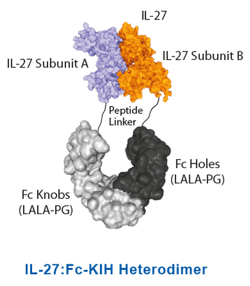
Interleukin-27 (IL-27) ist ein Zytokin aus der IL-12-Familie und kann verschiedene Signalwege anschalten, darunter den JAK-STAT- und p38 MAPK-Signalweg. Dabei können sowohl pro- als auch anti-inflammatorische Antworten hervorgerufen werden [10]. IL-27 besteht aus zwei Untereinheiten, IL-27p28 und EBI3. Das [IL-27 (mouse):Fc-KIH (human) (rec.)](https://www.biomol.com/de/produkte/proteine-und-peptide/zytokine/rekombinant/il-27-mouse-fc-kih-human-rec.-ag-40b-0236-c050) von AdipoGen Life Sciences ist ein heterodimeres Fc-KIH-Konstrukt, das an den IL-27-Rezeptor von Maus und Mensch bindet und so die Stat3-Phosphorylierung aktiviert. Aufgrund seiner heterodimeren Struktur zeigt das IL-27-InVivoKine™ eine höhere Aktivität als herkömmliche IL-27-Fc-Konstrukte [3].
| **Produktnummer** | **Produktname** | **Proteinkonstrukt** |
| --- | --- | --- |
| AG-40B-0236-C050 | [IL-27 (mouse):Fc-KIH (human) (rec.)](https://www.biomol.com/de/produkte/proteine-und-peptide/zytokine/rekombinant/il-27-mouse-fc-kih-human-rec.-ag-40b-0236-c050) | Heterodimer |
| AG-40B-0249-C050 | [IL-27 (mouse):Fc (LALA-PG)-KIH (human) (rec.)](https://www.biomol.com/de/produkte/proteine-und-peptide/zytokine/rekombinant/il-27-mouse-fc-lala-pg-kih-human-rec.-ag-40b-0249-c050) | Heterodimer |
### Einzigartige homodimere Zytokine: GDF-15
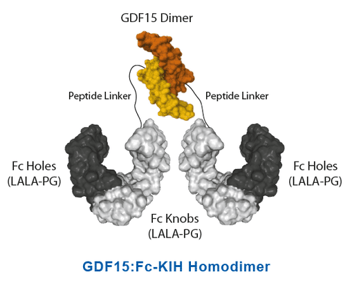
Der Wachstumsdifferenzierungsfaktor 15 (*growth differentitation factor 15*, GDF-15) hat vielfältige Wirkungen, unter anderem auf die Appetitregulierung, den Stoffwechsel, die Schwangerschaft und auf Immunantworten. GDF-15 wird momentan für die Behandlung vieler Stoffwechselkrankheiten, einschließlich Fettleibigkeit und Typ-2 Diabetes mellitus, sowie für Herz-Kreislauf-Erkrankungen erforscht. Das [Fc (LALA-PG)-KIH (human):GDF15 (mouse) (rec.)](https://www.biomol.com/de/produkte/proteine-und-peptide/zytokine/rekombinant/fc-lala-pg-kih-human-gdf15-mouse-rec.-ag-40b-0245-c050) von AdipoGen Life Sciences ist ein einzigartiges Protein mit lang anhaltender hoher Aktivität für *in vivo*-Studien. Während andere klassische GDF-15-Fc-Proteine große, inaktive Aggregate formen, bildet das GDF-15-InVivoKine™ ein biologisch aktives Homodimer [3].
| **Produktnummer** | **Produktname** | **Proteinkonstrukt** |
| --- | --- | --- |
| AG-40B-0245-C050 | [Fc (LALA-PG)-KIH (human):GDF15 (mouse) (rec.)](https://www.biomol.com/de/produkte/proteine-und-peptide/zytokine/rekombinant/fc-lala-pg-kih-human-gdf15-mouse-rec.-ag-40b-0245-c050) | Homodimer |
### Sie sind auf der Suche nach Zytokinen mit höherer Aktivität und Halbwertszeit für Ihre *in vivo- *oder *in vitro*-Studien? Dann ist [die neue Produktlinie InVivoKines™](https://www.biomol.com/dateien/AdipoGen--InVivoKines.pdf) unseres Herstellers [AdipoGen Life Sciences](https://www.biomol.com/de/adipogen/) genau das Richtige für Sie! Überzeugen Sie sich selbst von der Qualität und den Vorteilen dieser innovativen Lösungen für Ihre Zytokinforschung.
| **Produktnummer** | **Produktname** | **Proteinkonstrukt** |
| --- | --- | --- |
| AG-40B-0238-C050 | [IL-7 (human) (monomeric):Fc-KIH (human) (rec.)](https://www.biomol.com/de/produkte/proteine-und-peptide/zytokine/rekombinant/il-7-human-monomeric-fc-kih-human-rec.-ag-40b-0238-c050) | Monomer |
| AG-40B-0247-C050 | [IL-7 (human) (monomeric):Fc (LALA-PG)-KIH (human) (rec.)](https://www.biomol.com/de/produkte/proteine-und-peptide/zytokine/rekombinant/il-7-human-monomeric-fc-lala-pg-kih-human-rec.-ag-40b-0247-c050) | Monomer |
| AG-40B-0240-C050 | [IL-12 (mouse):Fc-KIH (human) (rec.)](https://www.biomol.com/de/produkte/proteine-und-peptide/zytokine/rekombinant/il-12-mouse-fc-kih-human-rec.-ag-40b-0240-c050) | Heterodimer |
| AG-40B-0250-C050 | [IL-21 (mouse) (monomeric):Fc (LALA-PG)-KIH (human) (rec.)](https://www.biomol.com/de/produkte/proteine-und-peptide/zytokine/rekombinant/il-21-mouse-monomeric-fc-lala-pg-kih-human-rec.-ag-40b-0250-c050) | Monomer |
| AG-40B-0235-C050 | [IL-23 (mouse):Fc-KIH (human) (rec.)](https://www.biomol.com/de/produkte/proteine-und-peptide/zytokine/rekombinant/il-23-mouse-fc-kih-human-rec.-ag-40b-0235-c050) | Heterodimer |
| AG-40B-0248-C050 | [IL-23 (mouse):Fc (LALA-PG)-KIH (human) (rec.)](https://www.biomol.com/de/produkte/proteine-und-peptide/zytokine/rekombinant/il-23-mouse-fc-lala-pg-kih-human-rec.-ag-40b-0248-c050) | Heterodimer |
| AG-40B-0233-C050 | [IL-33 (oxidation resistant) (human) (monomeric):Fc-KIH (human) (rec.)](https://www.biomol.com/de/produkte/proteine-und-peptide/zytokine/rekombinant/il-33-oxidation-resistant-human-monomeric-fc-kih-human-rec.-ag-40b-0233-c050) | Monomer |
| AG-40B-0221-C010 | [IL-37 (human) (monomeric):Fc-KIH (human) (rec.)](https://www.biomol.com/de/produkte/proteine-und-peptide/zytokine/rekombinant/il-37-human-monomeric-fc-kih-human-rec.-ag-40b-0221-c010) | Monomer |
| AG-40B-0241-C010 | [IL-38 (aa 1-152) (human) (monomeric):Fc-KIH (human) (rec.)](https://www.biomol.com/de/produkte/proteine-und-peptide/zytokine/rekombinant/il-38-aa-1-152-human-monomeric-fc-kih-human-rec.-ag-40b-0241-c010) | Monomer |
| AG-40B-0226-C010 | [IL-38 (aa 20-152) (human) (monomeric):Fc-KIH (human) (rec.)](https://www.biomol.com/de/produkte/proteine-und-peptide/zytokine/rekombinant/il-38-aa-20-152-human-monomeric-fc-kih-human-rec.-ag-40b-0226-c010) | Monomer |
| AG-40B-0227-C010 | [IL-38 (aa 3-152) (mouse) (monomeric):Fc-KIH (human) (rec.)](https://www.biomol.com/de/produkte/proteine-und-peptide/zytokine/rekombinant/il-38-aa-3-152-mouse-monomeric-fc-kih-human-rec.-ag-40b-0227-c010) | Monomer |
| AG-40B-0246-C050 | [Fc (LALA-PG)-KIH (human):Irisin (monomeric) (rec.)](https://www.biomol.com/de/produkte/proteine-und-peptide/zytokine/rekombinant/fc-lala-pg-kih-human-irisin-monomeric-rec.-ag-40b-0246-c050) | Monomer |
| AG-35B-0015-C010 | [Fc-KIH (human) IgG1 Control (rec.)](https://www.biomol.com/de/produkte/proteine-und-peptide/proteine/fc-kih-human-igg1-control-rec.-ag-35b-0015-c010) | Kontrolle |
| AG-35B-0018-C050 | [Fc (LALA-PG)-KIH (human) IgG1 Control (rec.)](https://www.biomol.com/de/produkte/proteine-und-peptide/proteine/fc-lala-pg-kih-human-igg1-control-rec.-ag-35b-0018-c050) | Kontrolle |
## Quellen
[1] [https://de.wikipedia.org/wiki/Zytokin](https://de.wikipedia.org/wiki/Zytokin), 03.06.2024
[2] [https://flexikon.doccheck.com/de/Zytokin](https://flexikon.doccheck.com/de/Zytokin), 03.06.2024
[3] [https://adipogen.com/invivokines/](https://adipogen.com/invivokines/), 03.06.2024
[4] [https://flexikon.doccheck.com/de/Rekombinant](https://flexikon.doccheck.com/de/Rekombinant), 03.06.2024
[5] [https://flexikon.doccheck.com/de/Fusionsprotein](https://flexikon.doccheck.com/de/Fusionsprotein), 03.06.2024
[6] [https://flexikon.doccheck.com/de/Fc-Fragment](https://flexikon.doccheck.com/de/Fc-Fragment), 03.06.2024
[7] Ridgway JB, Presta LG, Carter P. 'Knobs-into-holes' engineering of antibody CH3 domains for heavy chain heterodimerization. Protein Eng. 1996 Jul;9(7):617-21.
[8] [https://flexikon.doccheck.com/de/Neonataler_Fc-Rezeptor](https://flexikon.doccheck.com/de/Neonataler_Fc-Rezeptor), 03.06.2024
[9] [https://flexikon.doccheck.com/de/Interleukin-2](https://flexikon.doccheck.com/de/Interleukin-2), 03.06.2024
[10] [https://en.wikipedia.org/wiki/Interleukin_27](https://en.wikipedia.org/wiki/Interleukin_27), 03.06.2024
---
## Das könnte Sie auch interessieren …
WEITERE BLOGBEITRÄGE
##### Süße Versuchung, bittere Wahrheit: Diabetes im Visier der Forschung
Die steigende Zahl der an Diabetes erkrankten Menschen stellt das Gesundheitssystem vor große Herausforderungen, insbesondere durch die...
- [ELISA](https://ressourcen.biomol.com/de/biomol-blog/tag/elisa)
- [AdipoGen](https://ressourcen.biomol.com/de/biomol-blog/tag/adipogen)
- [Cayman Chemical](https://ressourcen.biomol.com/de/biomol-blog/tag/cayman-chemical)
- [BPS Bioscience](https://ressourcen.biomol.com/de/biomol-blog/tag/bps-bioscience)
- [Adipositas](https://ressourcen.biomol.com/de/biomol-blog/tag/adipositas)
- [Diabetes](https://ressourcen.biomol.com/de/biomol-blog/tag/diabetes)
- [Assay-Kits](https://ressourcen.biomol.com/de/biomol-blog/tag/assay-kits)
##### Biomarker für Autoimmunkrankheiten - APRIL & BAFF
Die B-Zell-stimulierenden Moleküle BAFF (B cell activating factor, auch bekannt als BLyS; TALL-1; CD257 oder TNFSF13B) und APRIL (ein...
- [AdipoGen](https://ressourcen.biomol.com/de/biomol-blog/tag/adipogen)
- [Marker](https://ressourcen.biomol.com/de/biomol-blog/tag/marker)
- [Immunität](https://ressourcen.biomol.com/de/biomol-blog/tag/immunität)
##### ACE2 - Der SARS-CoV-2 Rezeptor
Das vor 18 Jahren entdeckte SARS-Coronavirus (SARS-CoV) führt bei infizierten Menschen zu Atemwegserkrankungen.1 Bis heute gibt es keine...
- [AdipoGen](https://ressourcen.biomol.com/de/biomol-blog/tag/adipogen)
- [Arigo Biolaboratories](https://ressourcen.biomol.com/de/biomol-blog/tag/arigo-biolaboratories)
- [Coronavirus](https://ressourcen.biomol.com/de/biomol-blog/tag/coronavirus)
- [Antikörper](https://ressourcen.biomol.com/de/biomol-blog/tag/antikörper)
Biomol-Newsletter
Abonnieren Sie den kostenlosen Biomol-Newsletter und bleiben Sie bestens informiert über die neuesten Aktionen von Biomol. Zusätzlich erhalten Sie einen **10€ Gutschein** für Ihre nächste Bestellung.
Hier geht's zur Newsletter-Anmeldung! **
Wichtiger Hinweis
Unsere Produkte richten sich ausschließlich an Wissenschaftler*innen und Einkäufer*innen in Forschungseinrichtungen. **Eine Lieferung an Privatpersonen ist ausgeschlossen.**
Sie finden uns auch auf
[** ](https://www.facebook.com/biomol) [** ](https://www.linkedin.com/company/biomol-gmbh/) [** ](https://www.xing.com/companies/biomolgmbh) [** ](https://www.youtube.com/channel/UCRD-h8vgRJc2p83-y_ITJDA) [ ](https://mastodon.social/@biomol)
Rechtliches
- [ Datenschutzerklärung ](https://www.biomol.com/de/datenschutzerklaerung)
- Cookie-Einstellungen
- [ Markenzeichen ](https://www.biomol.com/de/markenzeichen)
- [ AGB ](https://www.biomol.com/de/agb)
- [ Impressum ](https://www.biomol.com/de/impressum)
Über Biomol
- [ Kontakt ](https://www.biomol.com/de/kontakt)
- [ Technischer Kundenservice ](https://www.biomol.com/de/technischer-kundenservice)
- [ Häufige Fragen ](https://www.biomol.com/de/haeufige-fragen)
- [ Versandkosten ](https://www.biomol.com/de/versandkosten)
- [ Produkt-Suchtipps ](https://www.biomol.com/de/produkt-suchtipps)
- [ Distributoren ](https://www.biomol.com/de/distributoren)
- [ Firmengeschichte ](https://www.biomol.com/de/firmengeschichte)
- [ Mitgliedschaften ](https://www.biomol.com/de/mitgliedschaften)
- [ Jobangebote ](https://www.biomol.com/de/jobangebote)
- [ Sitemap ](https://www.biomol.com/de/sitemap)
Kundenservice
Mo - Do, 09:00 - 17:00 Uhr
Fr, 09:00 - 16:00 Uhr
Tel: [+49-40-8532600](tel:+49-40-8532600)
E-mail: [info@biomol.com](mailto:info@biomol.com)
Auszeichnungen
[ ](https://www.biomol.com/de/awards)
Zahlungsarten

Versand
 Wir versenden mit UPS Express Saver.
**Keine** [Versand- und Kühlkosten](https://www.biomol.com/de/versandkosten) bei Online-Bestellungen über 1.000 € innerhalb Deutschlands *(gilt nicht bei Versand frischer Blutprodukte von [Research Donors](https://www.biomol.com/de/research-donors/))*.
[** ](https://www.facebook.com/biomol) [** ](https://www.linkedin.com/company/biomol-gmbh/) [** ](https://www.xing.com/companies/biomolgmbh) [** ](https://www.youtube.com/channel/UCRD-h8vgRJc2p83-y_ITJDA) [ ](https://mastodon.social/@biomol)
© 2025 Biomol GmbH - Life Science Shop | Kieler Straße 303a | 22525 Hamburg | Deutschland
```json
{
"@context" : "https://schema.org",
"@type" : "BlogPosting",
"author" : {
"@type" : "Person",
"name" : "Emily Locke",
"url" : "https://ressourcen.biomol.com/de/biomol-blog/author/emily-locke"
},
"dateModified" : "2025-07-07T13:21:08.067Z",
"datePublished" : "2024-06-19T22:00:00.000Z",
"headline" : "Revolutionierung der Zytokinforschung: InVivoKines™ von AdipoGen Life Sciences",
"image" : [ "https://ressourcen.biomol.com/hubfs/Imported_Blog_Media/InVivoKines_Preview-3.png" ],
"mainEntityOfPage" : {
"@id" : "https://ressourcen.biomol.com/de/biomol-blog/revolutionierung-der-zytokinforschung-invivokines-von-adipogen-life-sciences",
"@type" : "WebPage"
},
"publisher" : {
"@type" : "Organization",
"logo" : {
"@type" : "ImageObject",
"url" : "https://ressourcen.biomol.com/hubfs/Biomol/biomol-logo.png"
}
}
}
```